How Farm Mechanization Helps Reduce Harvesting Challenges

The Best Crops for Small Harvesting Machines
May 26, 2026
Common Mistakes to Avoid During Field Cultivation
June 10, 2026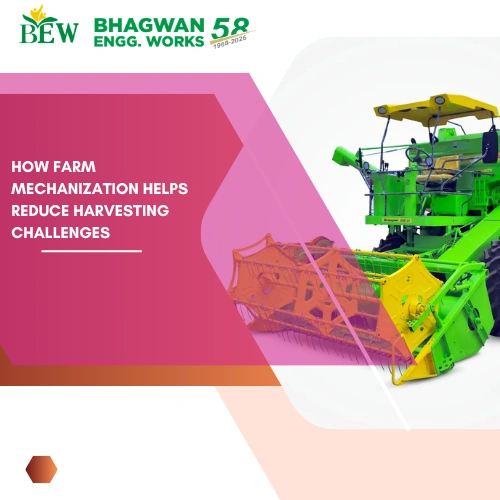
Today, the farming business is undergoing dramatic changes as farmers explore many new ways to optimize productivity, reduce staffing needs, and boost the efficiency of a harvest. The newer trend within modern agriculture that has caught on so quickly is farm mechanization. With the emergence of modern farm equipment the work of harvesting has become more time-efficient, precise and inexpensive. Given the current scenario of scarcity of human capital and vagaries of the weather, mechanization is the way forward both for small time farmers and corporate farms.
Farm mechanization is the process of using machinery/technologies to replace manual labor in agricultural operations. It has revolutionized Agriculture by increasing productivity through mechanized systems, from soil preparation to harvesting and post-harvest operations. Harvest mechanization has played important role in decreasing crop losses, time saving and fatigue-less operations.
The Growing Importance of Farm Mechanization
Harvesting is one of the most important terms in farming as any delay may directly affect a crop’s quality and hence, its market value. Generally, traditional harvesting techniques require excess manpower and time, especially during busy harvesting season. In fact, farmers around the world are facing difficulties harvesting crops due to rising wages and a shortage of labor.
Farm mechanization is the solution of this problem. It is possible to operate modern machines at higher speeds and greater efficiency, covering the same area in less time while maintaining crop quality. Hence, this enables harvesting crops at right maturity and to have minimum loss due to late harvesting.
Greater mechanization also contributes to more efficient farm management by allowing operators to become more consistent and less reliant on seasonal labor. It enables planning and timing of activities, such as taking harvest advantage of short windows of nice weather.
Reduced Labor Dependency in Agriculture
The main benefits of farm mechanization include reduced dependence on labor. Many major agricultural-producing areas are experiencing a shortage of skilled labor during harvest seasons. The use of mechanized equipment can allow one farmer to accomplish what many workers would in the same amount of time.
Machinery such as harvesters, threshers, and reapers enables farmers to accomplish work that would otherwise require numerous workers. This reduces labor costsand time lost during important harvesting seasons.
For instance, a farmer who employs a Multicrop Thresher will enhance his threshing efficiency compared to manual threshing, with faster grain separation from the stalks and a significant reduction in grain losses.
Faster Harvesting Improves Crop Quality
Timing is very important in harvesting. Farmers have to decide the right time to harvest based on growth rate and climatic conditions. If we harvest the crop early then our yield potential crop will be short. In the other hand late harvesting may suffer weather damage, pest attack and quality loss.
Farm mechanization accelerates harvesting operations, allowing farmers to safeguard quality and optimize returns. Mechanized harvesting machinery can complete harvesting operations more quickly, so farmers will face less risk of sudden rain, storms, high water, or heat.
The threshing and harvesting equipment at present day also helps to clean the grain and reduce their contamination. The machines help to process in a betteruniform way than what the manual method. So, the farmer gets high-quality produce for sale in the market.
Many of the farmers looking into the possible uses of the Multicrop Thresher Machine are probably more concerned with harvesting a quicker, higher-quality crop and less focused on the ability to harvest a multitude of different crops.
Mechanization Supports Multiple Crop Harvesting
Farmers are growing different types of crops all the year round leading toward agricultural diversification that require machinery suitable to undertake various agricultural practices.
Threshers and other harvesting equipment are now capable of handling wheat, rice, maize, millet, pulses and oilseeds. Consequently, a farmer can operate a single machine throughout a cropping season rather than investing in one for each crop.
The demand for Multicrop Threshers is growing because these machines are more versatile for farmers with small and medium farms; they can use one machine to carry out a variety of harvesting operations.
Reduced Post-Harvest Losses
One of the greatest problems in the field of post-harvest handling still exist in many parts of the world, where manual harvesting and processing is often the prevailing method of handling commodities. Grain losses incurred during threshing, handling, and storage can erode the farms’ bottom line.
In addition to trade losses, exposure to other fields and mishandling during storage also contribute to wastage. Modern harvesting machinery can help minimize these wastages. The machinery is capable of harvesting with optimum precision and in the process decrease the damage to the grains.
Additional benefit of efficient threshing systems are the higher quality and storage because less moisture is retained and they are easier to transport. Cleaner products are also easier to store and buyback at the market.
Farmers often shy away from Multicrop Thresher Machine Price before buying since they desire to have a machine that will give them savings in the long run through increased productivity and reduced crop losses.
Cost Efficiency and Long-Term Savings
Although expensive to acquire, milling efficiency is often increased due to lower total operating costs… Cheaper labor costs, quicker harvesting, lower crop losses and an increase in yield result in the cost efficiency always being improved over time.
Currently, farmers also take the consideration of durability, maintenance requirement, spare parts accessibility and fuel consumption of equipment into account while buying the machinery. Farmers searched for the keyword Multicrop Thresher Price In India to seek the cheap and best harvesting machine for the environment.
Various type of financing options and government farming subsidy schemes for development of mechanization are also being accessed by small and medium farmers.
Technology Is Modernizing Indian Agriculture
India’s farming industry is quickly adopting technology-centric agriculture practices. New state-of-the-art equipment, precision farming techniques and automated harvesting equipment are aiding farmers to become more productive amid soaring input expenses.
Businesses like Bew India are leading the way through. By providing modern agricultural machinery tailored to the 21st century, farmers can reach new levels of effectiveness in their harvests.
As public awareness about mechanized agriculture grows, farmers are investing in harvesting equipment for a cleaner, more efficient farming process.
Key Factors Farmers Should Consider Before Purchasing Machinery
Before investing in harvesting machinery, farmers should carefully evaluate several important factors:
- Factors affecting the production of off-take-1) size of farms and type of crops.
- Machine capacity plus os. Efficiency
- Fuel and maintainence costs
- Obvious availability of parts and servicing mechanisms
- Making it easy to operate.
- Budget and financing options
Most of the buyers doing the research of Multicrop Thresher Price want not only the cheapness but also the stablity and effectiveness of the machinery.
Conclusion
Farm mechanization is significantly contributing to overcoming numerous difficulties faced during harvesting in advanced agriculture. Advances in harvesting speed, reduction of manual labor dependence, minimizing of losses and enhancing of efficiency are possible thanks to the technological interventions introduced by agricultural machinery.
In response to changing farm conditions, mechanized solutions are emerging as a vital aspect of sustainable growth in agriculture. For farmers operating small family farms or medium-scale businesses, acquiring efficient harvesting machinery can have a positive impact on future farm productivity.
As awareness increases, technology advances and access to machinery improves so farm mechanization will go a long way in defining the future of agricultural practices in India and the world.