
Key Factors That Affect Sowing Efficiency on Indian Farms

Low-Cost vs Long-Term Value: What Should Farmers Consider?
August 26, 2026
Modern Solutions for Faster Field Preparation and Sowing
September 4, 2026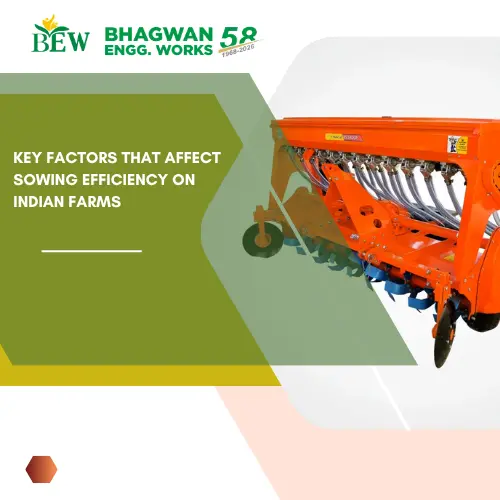
Sowing is among the most critical steps in crop production. The quality and speed of sowing can have a significant effect on seed placement, crop establishment, labour, and productivity of the farm. In Indian farms where the soil types, crop rotations, size of the fields, and the straw residue management practices all differ widely, it is important to select the appropriate method of sowing.
The use of current-day machinery has streamlined the process of mechanized field operations on the farm, allowing operations to be carried out in a timely manner. Despite this, the efficiency of sowing is not solely determined by the machinery. Various factors affect the efficiency of machinery, including soil tillage, moisture, crop residue management, machine adjustments, conditions of the field, and the operator’s level of skill.
Soil Condition and Field Preparation
The soil state is one of the earliest factors affecting the sowing performance. Too wet fields may lead to very high compaction of the soil and increase the mobilization effort of the machinery. Too dry conditions may influence the seed setting and the germination process.
Correct preparation of the field results in creating a good environment for the seed. The farmer should take into account the soil moisture, surface condition, and the field leveling before proceeding with the sowing operation. A well-prepared field results in easier working of the agricultural machinery with equal depth and spacing.
Crop Residue Management
Crop residue can be an issue where quick field preparation following harvest is needed. Paddy straw and stubble on the field can cause problems with conventional sowing if not dealt with adequately.
A residue-management solution that saves time between harvesting and sowing may be appropriate. Machinery that manages the residue while doing the necessary tillage and sowing may be efficient rather than doing the task several times. This is vital in regions with a brief period of time between two crops.
For farmers who only grow paddy residue, a Paddy Stubble Super Seeder can be used to combine residue management and sowing. This equipment is designed to facilitate field management of the residue and timely establishment of the subsequent crop.
Machine Settings and Calibration
Accurate machine settings are necessary for uniform sowing. The seed rate, sowing depth, row distance, and the operating speed should be set according to the crop and field conditions.
Farmers must ensure the machine has been calibrated properly before starting big operations. If not calibrated properly, seeds might not be distributed evenly or sown at the same depth, affecting crop production.
Routine checks of parts like seed metering units, openers, blades, and other moving parts can help make sure everything continues to operate the same during the season.
Operating Speed
Speed is also a factor that will directly impact sowing quality. While increased speed of operation could be advantageous for operational efficiency for the farmer, the potential negative impact on seed placement and machine performance must be considered.
The optimum operating speed is determined by the type of machine, the working conditions, the amount of cover, and the crop. In general, the operator should aim to find the optimum working speed to give a compromise between field capacity and sowing accuracy.
Choosing the Right Agricultural Machinery
The selection of equipment has to depend on farm size, crop, soil condition, residue, and number of operations. A farmer should see how a machine can perform the required operation in the minimum number of passes, and how quickly it can do the work.
Super Seeder allows operators to combine several field operations with residue management and sowing, saving time if farmers wish to finish the sowing work within a short window of the season.
Equipment purchases should not be evaluated solely on initial price. Operational efficiency, ease of maintenance, fuel economy, equipment lifespan, availability of spares, and the quality of after-sales support are also important considerations.
Understanding Machinery Cost
Cost will obviously be one of the most important factors in selecting farm equipment. Farmers should ensure that they compare equipment based on its specifications, capacity, service life, maintenance, and efficiency in their farming systems.
Looking for the Super Seeder Price: While price is certainly important, it shouldn’t be the only consideration. A machine that can increase productivity and eliminate one or more separate field operations could be a better investment in the long run.
Likewise, the farmers studying the Super Seeder Machine need to “Compare the specifications and the applications rather than the purchase price. “
If you are looking for Super Seeder Price India information and prices, you should be aware that prices can change depending on the machine configuration, features, producer, location, and accessories used. Farmers should therefore ask for full specifications and know what is included when pricing a machine.
Also, the price of a Super Seeder Machine Price depends on the capacity, design, technology, and manufacturer. By comparing these, it can be determined which is best suited for the farmers’ needs.
Importance of Timely Sowing
Timeliness is one of the most significant considerations in Indian agriculture. Late sowing can have an impact on the duration of the crop cycle and can pose problems when the subsequent crop harvesting or sowing time begins.
Good machine performance may allow farmers to complete their field operations within the allocated period. Reducing passes, precise machinery functioning, and crop straw management shall lead to a faster way to prepare the field for sowing.
Operator Experience and Maintenance
No matter how sophisticated the machinery operated, if it is not operated correctly and maintained, it will not perform to its optimum potential. Operators should be familiar with the recommended operating parameters and procedures associated with the piece of equipment being operated.
Preventive, regularly scheduled maintenance can prevent unexpected breakdowns during busy farming time. Wash, oil, check rusted parts, and replace damaged parts on schedule.
In addition, farmers should select machinery from manufacturers who may offer technical assistance, spare parts, and after-sales service, as needed.
Conclusion
Sowing efficiency is not only about dropping seed into the ground. It is also about understanding the condition of the ground, pasture residue, calibrating the sowing machinery, the travel speed, adequate preparations at the right time, choosing the appropriate machinery, and carrying it out properly.
Proper farm equipment can aid Indian farmers in minimizing time delays during operations and residue handling, which then leads to increased farm field productivity. Machinery should be selected based on farm needs, not just the cost of purchase, to help maximize farm machinery investments.