Low-Cost vs Long-Term Value: What Should Farmers Consider?

One Farm, Different Machines: Which Option Makes More Sense?
August 25, 2026
Key Factors That Affect Sowing Efficiency on Indian Farms
August 28, 2026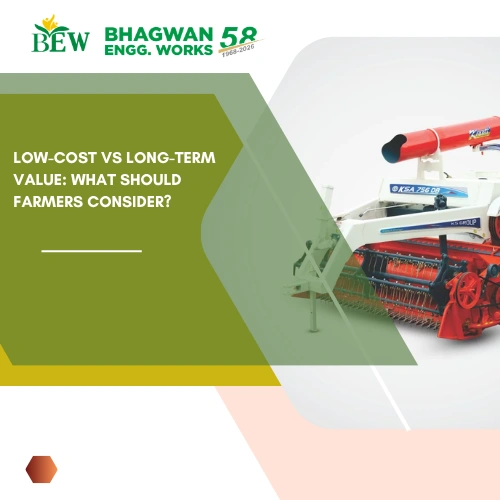
Selecting equipment is a significant decision for farmers. Initially, a machine with a lower purchase price might appear to be the most economical; nevertheless, the most affordable choice today may turn out to be the highest cost tomorrow. The initial cost of machinery represents only a share of the total cost. Variables such as servicing, fuel efficiency, idling, repairs, labour needs and replacement prices all influence the true cost of machinery.
This is where the farmer needs to take a long-term view and look not at what the machine costs to buy, but what it is capable of in its working life. Many a good machine may cost a little more initially but will give the operator superior performance, less downtime and overall better value.
Understanding the Real Cost of Farm Equipment
Farmers tend to compare the purchase price as the initial consideration when searching for a new machine. But two implements with similar capabilities can differ greatly in running costs.
A less expensive machine could have higher repair costs and need more replacement parts or maintenance. If it breaks down during a crucial part of the harvesting season, then delays may also lead to higher labour charges and impact the whole farming calendar.
Alternatively, agricultural equipment meant for everyday use might be more robustly built and more durable. The upfront investment might be larger, but the consistent work output can make it more cost-effective over the course of several seasons.
Why Equipment Quality Matters
Hard-working farm machinery: If you buy tough machinery, then you will find that it will stand up to even the harshest farm conditions. Dust, crop, chaff, long hours, bumpy fields, and regular journeys can all take their toll on agricultural equipment.
Let’s say, for instance, that a Straw Reaper must operate through heavy amounts of crop residue. A machine designed with tough parts and an efficient operating system can go farther with fewer interruptions.
In order to avoid being misled by the price of a machine, farmers should check the quality of main parts, the simplicity of maintenance, the availability of spare parts, and the manufacturer’s support.
Comparing Initial Price With Long-Term Value
When we compare equipment, it is important that we look at the total cost of ownership rather than simply the cost of the purchase. It is possible to look at the total cost of ownership by adding together purchase costs, maintenance costs, repairs, fuel, labour, spare parts, and disposal costs.
Let’s say one type of equipment costs less but needs frequent repairs, and another type has a higher cost of purchase but is “problem free” for a long period of time. The latter case could be the more economical choice.
This method is good for checking Bhusa Machine Price. Look around, check the various prices for different specifications. Don’t always go for the lowest; study the capacity, construction, the amount of maintenance needed, etc. Before making your choice.
Productivity Can Make a Higher Investment Worthwhile
Time is also a valuable resource in farm business. The quicker the machine performs, the less workforce it needs and, consequently, it frees time for the farmers.
Higher productivity can be an advantage in short harvesting windows. Farm operation stages can be affected by equipment problems and delays; this could occur on more than one stage.
When considering the Reaper Price, farmers must therefore think about the value of what they are getting for their money. Capacity, speed of operation, need for a power source, performance in the field, comfort of operation, and durability can all affect its true worth.
Maintenance and Repair Costs Matter
Lack of maintenance is an issue even with machines of good design. Well-designed machinery should facilitate servicing and may decrease the frequency of machinery failures.
Prior to buying any of the machines, farmers should check if replacement parts are easily available and if local service technicians are able to service them. Access to backup in case of the slightest mechanical failure should help to avoid any significant operational setbacks.
In addition, we should adhere to the maintenance schedules provided by the equipment suppliers. By keeping the machinery well maintained by cleaning, lubricating, checking, and replacing components when they wear out, the machinery will last much longer.
Choosing Equipment Based on Farm Requirements
No one machine is suitable for all farmers. The best machine for you will depend on the size of your farm, type of crops grown, the condition of your fields, nature of work required, the availability of labour, and whether it will need to be tractor compatible.
A small farm may not require the top-of-the-line machine, just as a large commercial farm may not be able to use even the most basic model efficiently.
The frequency of usage and type of workload should be taken into account when selecting equipment. Extra cost for unintended capacity does not necessarily mean better value.
What to Check Before Buying
When shopping for new equipment, farmers need to look beyond the price. Specifications, quality of construction, working capacity, fuel (or power) consumption, warranty, spare-parts supply and after-sales service are critical.
Online searches can be a valuable initial resource, but advice from experienced farmers and dealers can also highlight real benefits and problems.
If you are looking for Straw Reaper Price and have many models to compare, it can be helpful to see all the different prices side by side. The more expensive the Straw Reaper Price, the better the components, capacity, technology, or support is likely to be.
Cheap Equipment Is Not Always Better Value
However, in certain cases, purchasing a cheap machine is the right choice if the specifications are suited to the farmer and the product is from a trusted manufacturer. The problem arises when only the price influences the buying decision.
Purchasing equipment that cannot handle the job will result in high operating costs and low productivity. Equipment failures will also incur non-obvious costs when the equipment is purchased.
It should be replaced with the question “which machine is offering the most value for the job I am doing?”
Making a Smarter Long-Term Investment
Before making a comparison on Straw Reaper Machine Price, farmers need to identify what their true needs are and what features they require. A machine that can deliver a good balance of reliable operation, trouble-free maintenance, capacity, and after-sales service can be more economical in the long term.
The aim is not to buy the most costly equipment. It is to select machinery that provides value for money while meeting performance and reliability expectations.
Final Thoughts
The choice of farm machinery is, in fact, a question of juggling the present budget with the future productivity. The low purchase price may be appealing but, in the end, the true value usually relies on durability, maintenance costs, efficiency, and service facilities.
Farmers who consider the total cost of ownership (cost of machinery over its entire lifespan) are making choices that are good not just today but for years to come. Weighing the price against quality, output, longevity, and service will help prevent costly missteps.