Modern Solutions for Faster Field Preparation and Sowing

Key Factors That Affect Sowing Efficiency on Indian Farms
August 28, 2026
Your Next Crop Depends on What You Do After Harvest
September 7, 2026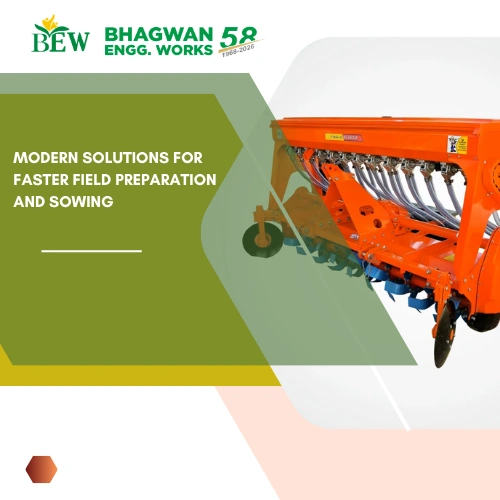
Agriculture is evolving at a faster pace as farmers seek new options that are time-saving, cost-reducing, and increase field productivity after harvesting activities. One of the most time-consuming and difficult tasks in post-harvest operations is preparing the land for the next crop; crop residues – especially paddy straw are a major hurdle in field preparation, which delays sowing. Modern machinery is positively contributing to addressing such challenges of farming and making farming practices more efficient and sustainable.
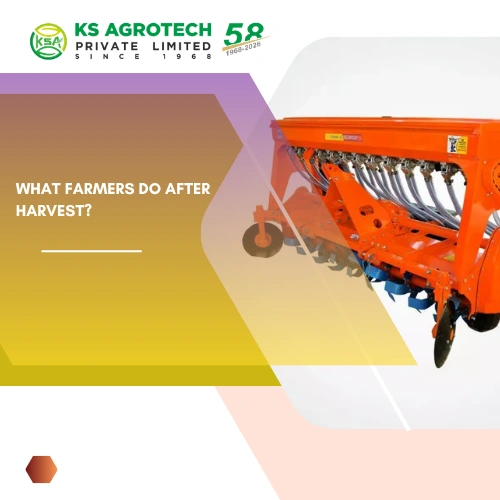
Among the most innovative innovations in this field is the Super Seeder. This is a type of machinery that aims to combine residue management and sowing by leaving one operation as a combination of residue management and sowing or planting. Consequently, farmers can prepare the land as well as the cultivation for the next crop at the same time.
Why Faster Field Preparation Matters
The time lag between harvesting and sowing the next crop is generally low. Any delay in this process may create chaos in the crop calendar and may be responsible for lower productivity. Conventional field preparation may involve repeated passes of machinery, thereby requiring more fuel, workforce, and time.
A more modern solution is to use modern machinery. The various key operations in a field can be consolidated, increasing the time between passes for the machine. This time can be used productively by saving many hours and allowing the seed to go into the ground within the correct time frame.
Using this type of field preparation can also improve soil conditions. Managing residues effectively will allow the residue to stay mixed in the soil, instead of (unnecessarily) burning or hauling it away. This will promote better soil organic matter.
Managing Paddy Residue More Efficiently
Managing paddy straw has become a significant issue in several regions of the country. There is a vast amount of straw remaining in the field once the rice crop has been harvested. It is essential for the farmer to find an appropriate solution to deal with the residual straw before planting the subsequent crop.
A Paddy Stubble Super Seeder is perhaps the best implement to use to address this agricultural concern. This type of seeder can be used as a means to overcome paddy trash, particularly when combined with the seed drill. Farm operations can therefore focus on minimizing repeated tillage operations and cutting weeds without resorting to choking green brush and other environmentally damaging practices.
Residue management does not always require removal of the material. In a sustainable soil-management system, crop residue, as a beneficial source of organic material, can be left in the field to help reduce waste. Proper residue management increases the value of residues to the soil.
Combining Sowing and Residue Management
The main benefit of new forms of agricultural equipment is that they can do many tasks efficiently. A Super Seeder Machine is beneficial for farmers to handle the remains of the field after harvesting and, at the same time, sow the seeds into the ready land. As a result, the period from harvest to planting is shortened.
For those operating over large acreages, efficiency of operation makes a real impact. Doing fewer passes in the field results in more savings on fuel, fewer labour hours, and fewer operating hours of equipment. It depends on the individual farm, depending upon the soil type, crop residue levels, machinery used, and systems of farming adopted.
Selecting a machine depends on other factors such as size of field, number of tractors, and compatibility with other equipment. Farmers must weigh factors like capacity, working width, and ease of maintenance against operating conditions before purchasing.
Understanding Machinery Costs
It is of course necessary to consider the cost prior to purchasing any agricultural implements. Looking around for Super Seeder Price India will at least give you some indication as to the going rate, but the ultimate cost will depend upon the machine set up, working width, features available, manufacturer’s specifications, etc.
Farmers with more specific needs often find comparing equipment on value rather than purchase price to be more meaningful. When choosing machinery, it is necessary to consider factors such as fuel savings, labour needs, productivity, robustness, maintenance costs, and support post-purchase.
For instance, a farmer seeking new machinery for certain field dimensions might query ‘7 Feet Super Seeder Price’ to find an affordable model within a defined working width. Assessing the machine’s specifications together with the price enables more cost-effective ownership.
Choosing Equipment for Modern Farming
Select to match actual field conditions. Machinery selection should be based on the real needs of the farm and not on presentation or cost. Machinery needs to be appropriate to the type of soil, rotation program, residue levels, tractor output, and size of farm.
Another factor is that a reliable machine must be. They have to be easy to use and to repair. Access to service, spare parts, and technical assistance can be crucial during the busy sowing time when machines can slow down the whole process.
Farmers searching for Super Seeder Machine Price may find that when comparing options, they encounter various configurations and specifications. Rather than considering just the number, take time to understand what the machine entails and in what way its specifications align with the needs of the farmer.
Moving Toward More Sustainable Agriculture
Today’s field preparation involves more than just quick turnaround. It also involves efficiency in resource use and elimination of inefficient processes. Higher residue control can eliminate burning, and integrated seed placement solutions can eliminate operations in the field.
Researching Super Seeder Prices as well as the technical data, warranty conditions, service & support, and operating costs can also prove advantageous to farmers. If chosen wisely, a machine can be a benefit to the long-term machinery plan.
With improvements in agricultural machinery, multifunctional solutions may become essential. Machinery that simplifies multitasking, such as residue incorporation and sowing, will allow farmers to make the most of short sowing opportunities and also facilitate greater care of the environment.
Conclusion
Efficient field preparation can improve flexibility for a farm during critical times. Equipment today can potentially eliminate a field pass, handle more crop residue, and finish planting in time.
Faced with a potential investment, it is important for any farmer to look at the specifications, running costs, dependability, and overall value of the machine. Having the right equipment can make the seasonal agribusiness far easier and greener.