One Farm, Different Machines: Which Option Makes More Sense?

Turn Post-Harvest Cleanup Into an Easier Task
August 24, 2026
Low-Cost vs Long-Term Value: What Should Farmers Consider?
August 26, 2026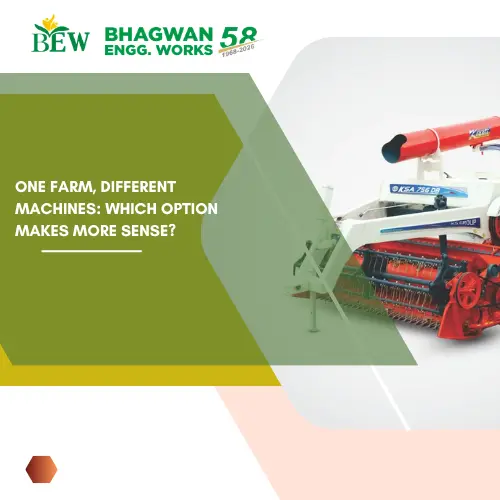
Today’s agriculture is far more complex than planting and harvesting. Once the crop is mature, the farmer must also take into consideration threshing, straw collection, stubble destruction, and prepping the field for the next crop cycle. Various implements have been developed to suit each operation, and selecting the right one can have a significant impact on time, person-hours, and farm productivity.
Several types of equipment used in agriculture, for instance, are: Combine Harvester, Tractor, Straw Reaper, Baler, and Rotavator. All of them have different purposes: a combine is used for harvesting and threshing, a tractor can be used for many different field tasks, a baler is used for making bales of crop residues, and the rotavator is used for the preparation of the soil. It may be desirable to have one that is used on the leftover straw.
Why Straw Management Matters
A large quantity of crop residues may be left in the field after harvesting. When left unmanaged, these can hinder the operation of subsequent field processes. The collection of such residues by hand is labour-intensive and time-consuming, the usual methods of removal being less than ideal for the requirements of today’s farm.
Here, a specialized straw-handling machine can be the answer. Instead of getting rid of the leftover straw, farmers can process it better. Collect it, chop it, and deal with it.
What Makes This Machine Useful?
This machine is particularly useful in that it allows the farmer to concentrate more on the straw handling portion of the operation after the crop has been harvested. Instead of two time-consuming operations, the operation can be accomplished with a single machine in one pass over the field.
The Straw Reaper is effective at collecting and handling crop residues. It functions by working to gather the remains of the straw in the field and convert it to a more manageable state. This, in turn, can cut the manual labor required for clearing and managing straw.
Besides saving money, another crucial advantage is time-saving. Since it is harvesting season, each hour is critical, as farmers usually prepare their next field in the shortest time possible. More rapid Residue Management can help to minimize the delay.
Better Use of Crop Residue
Crop residue need not always be regarded as waste. For the farmer’s needs, there are many possible uses of straw that has been processed. They can be used as food for animals, stored for future needs, or disposed of in other ways depending on the crop being grown and the surrounding farming practices.
The machine will crush the straw, resulting in a more convenient form for handling and easier transport. It can be particularly attractive for farmers who are used to handling a large residue amount.
Reduced Dependence on Manual Labour
Labour supply is a factor to bear in mind, as labour shortages are common in agriculture during busy periods of harvesting, and straws by hand can also be very time-consuming.
This machine has the potential to lessen the manual labor needed to manage crop debris after harvest. When used correctly, it is capable of covering a lot of ground more quickly than doing it manually, and may enable farmers and farm laborers to spend more time on other facets of farming.
Cleaner Fields After Harvesting
A cleaner field can help the next stage of the farming process. If there is too much loose straw, it can cause problems with some of the fieldwork and make it difficult to move around.
It is also capable of reducing final residue by handling the leftover residue, thus facilitating a cleaner working environment, an advantage particularly when farmers want to move fast to the next step of tilling or sowing.
Understanding the Cost Before Buying
Price is undoubtedly among the top considerations for farmers purchasing agricultural equipment. However, the Bhusa Machine Price can be affected by different factors based on the machine specifications, capacity, quality of build, working width, and the features offered.
Likewise, the Reaper Price is likely to vary greatly between brands and models. Farmers should not only consider the basic purchase price, but also how frequently the piece of equipment will be used and how much potential labour and time savings it might offer over future years.
The price of the Straw Reaper may be influenced by the power needed, construction standards, cutting and collection ability, and the crop type which the machine is designed for. These factors can be used to match the machinery with the farmer’s real needs rather than choosing the least expensive machine.
What Should Farmers Check Before Purchase?
Prior to purchasing this kind of equipment, it is necessary to question the benefits by looking at how it fits with the rest of the farm. For example, farmers need to look at compatibility with their current tractor on the farm, the working capacity, power or fuel requirements, and the ease of maintenance, support, and spares.
The cost of the machine should therefore be considered in conjunction with the expected productivity and running costs. A slightly higher purchase price of a machine might be justified by its superior performance, longevity, and reduced maintenance.
Farm size is yet another factor. A person in control of only a few acres would not have the same needs as a person controlling hundreds of acres. It should be selected according to acres, type of crop, number of uses per day/week, and the power of the tractor.
Final Thoughts
Every machine is designed for a specific application on a modern farm, as one machine cannot be utilized for all; so a combine harvester, a tractor, a baler, and a rotavator can all be utilized, but the question of straw handling can only be achieved by dedicated straw equipment.
If you are a farmer wishing to reduce manual work, save time, clean fields, and utilize crop stalks and sticks, then this machine can be a useful instrument. Compare specs, expected results, maintenance, and cost.
All in all, the best agri-machines are not always the most costly. They are the ones that correspond to your farm workload, work smoothly with your current farm equipment, and deliver good results many times in a row.