
Comparing Manual and Mechanical Reaping Methods

Compact Harvesting Technology Transforming Small-Scale Farming
February 5, 2026
Harvesting Equipment Selection Based on Farm Size & Crop Type
February 10, 2026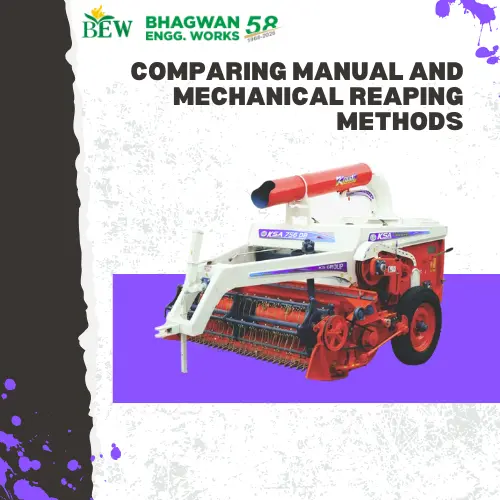
Harvesting is also one of the most important agricultural processes, which has a direct impact on crop yield, quality, and profitability. Traditional manual reaping and modern mechanical reaping have been the two primary means of reaping in the past, which farmers use. Both of these methods have some advantages and limitations, to be applied according to the size of the farm, availability of labor, and available budget. The knowledge about the distinctions between the reaping that is manual and mechanical allows farmers to select the most appropriate one to use in their work.
Understanding Manual Reaping
Manual reaping entails the harvest of crops with the use of manual tools like sickles. This has been the practice of generations and it is still widespread in areas where farms are small and where mechanization is not very high.
Manual reaping enables the farmers to cut the crops carefully with minimal use of machines. It is commonly used where the ground is not even or on those areas that machines can easily access. This is however, a very labor intensive and time-consuming approach and thus not as efficient as large scale farming.
Advantages of Manual Reaping
It is an inexpensive method of reaping, which is one of the major strengths of manual reaping. The equipment involved in farming is not expensive and the farmers are able to afford it because they have limited financial resources.
Manual harvesting also enables more control over cutting which may be a good option for sensitive crops or rough grounds. Moreover, it offers jobs in the rural regions where there is a high labor supply.
Limitations of Manual Reaping
Although it is a very simple process, manual reaping is associated with serious disadvantages. It involves a huge number of workers who may be a nuisance to organize during the delivery of bountiful harvests. The shortage of labor can usually result in late harvesting, which puts the crops at a greater risk of losses.
Manual processes are also strenuous and time consuming. Harvesting that is prolonged exposes crops to weather conditions such as either rain or wind that may decrease the quality and quantity of the grain.
Introduction to Mechanical Reaping
Mechanical reaping- this involves machines that are used to harvest crops in an efficient and uniform manner. These machines are usually mounted on the tractor or will be self-propelled and will be used to harvest such crops as wheat, paddy and barley.
Mechanical reaping facilitates the process of harvesting by harvesting huge slopes within a short period of time. The reapers of modern design are also aimed at minimizing the loss of grains, enhancing the consistency of the cutting and are becoming a more and more popular option with farmers.
Benefits of Mechanical Reaping
Speed is one of the greatest benefits of mechanical reaping. With machines, it is possible to harvest vast fields within a fraction of the time that it takes to harvest the fields manually hence harvesting will occur in time.
Mechanical reaping will also help minimize on manual labor especially in areas where there is a shortage of labor. Regularity in the cutting height and proper management of crops lead to high quality of harvest and less loss.
Cost Considerations
Manual reaping also has a low initial cost but the labor costs can be extremely high in the long run. Mechanical reaping involves a start up cost that depends on the type of machine, capacity and features.
Farmers usually look at the alternatives based on a comparison between long term labour-time savings and initial investment. Understanding the reaper price helps farmers determine whether mechanical reaping offers better value over multiple harvest seasons.
Impact on Crop Quality and Yield
Reaping by hand may result in irregular cuts and loss of grains as a result of tiredness or lack of uniformity. Mechanical reaping, in its turn, provides equality in the cutting and gathering of crops.
A high level of consistency will decrease shattering and contamination, resulting in cleaner produce and a higher value in the market. Increased quality production leads to high farm income.
Time Efficiency and Productivity
Mechanical reaping has a great contribution to productivity in that it saves time spent in harvesting. Quick harvesting enables the farmer to get the next crop ready in the fields by the end of the year which helps in supporting multiple crop production in a year.
On small scale, manual reaping is effective but in most cases, productivity is hampered by the slow pace of activities and increased dependency on labor.
Suitability for Different Farm Sizes
In very small farms, or where machines are not able to reach, it is better to use manual reaping. Mechanical reaping can be used on medium-sized and large farms where speed and efficiency are the key.
Small reaper machines have brought about innovations that have enabled mechanical reaping to be affordable to non-large scale farmers that have aided the transition between traditional and modern practices.
Environmental and Social Considerations
Manual reaping offers low carbon footprint but exerts much physical burden to the workers. Reaping is done by machines thus saving manpower, but also it burns fuel and it needs maintenance.
There is a need to balance efficiency and sustainability, and current machines are more and more developed to maximize fuel consumption and reduce the environmental footprint.
Conclusion
The use of both manual and mechanical reaping techniques in agriculture is justified. Manual reaping is still applicable in small scale activities where there is plenty of labor, though mechanical reaping is faster, more efficient and there are better quality crops. Due to the current transformation of farming, mechanical reaping is now being adopted as a crucial production means for farmers who want greater productivity and profitability in the long run. The decision of the appropriate reaping approach would be dependent on the size of the farm, resources and their long-term objectives.