Affordable Plough Options for Small and Medium Farms

How Bund Makers Improve Water Management in Agriculture
February 12, 2026
Round vs Square Baler: Which Option Is Best for Your Needs?
February 18, 2026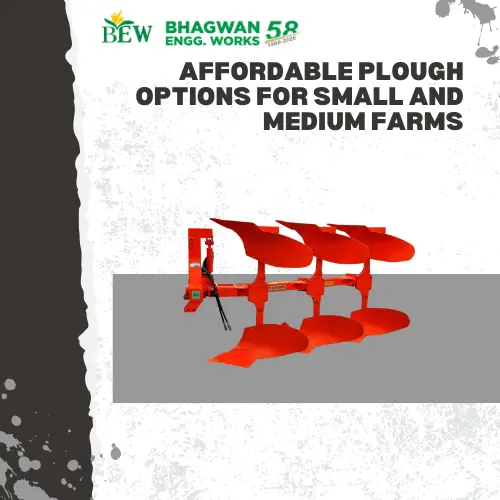
One of the major activities in land preparation is ploughing. It assists in soil loosening, enhancing soil aeration, weeding and providing an appropriate seed bed during planting. In the case of small and medium farms, it may make a difference in the selection of the plough, which will influence directly the productivity and profitability. Nevertheless, cost is a major issue. Fortunately, a number of low priced ploughs are available in the market that can perform well without going beyond the budget.
Importance of Choosing the Right Plough
Farmers with a small and medium size tend to be working with a small budget. The investment in agricultural machinery should be able to provide value in terms of durability, efficiency and saving in the long run. Right plough guarantees the right soil turnover, greater soil moisture retention and greater crop germination.
There is no reason to choose a plough that is cheap and of low quality. Rather it involves prudent consideration of the size of farms, type of soil, capacity of tractors, and patterns of cultivation.
Popular Affordable Plough Options
Various kinds of ploughs are also in use on small and medium enterprises:
1. Moldboard (MB) Plough
MB plough is a very common plough used in primary tillage. It is also formed so as to cut, bring up and turn the soil to a good depth burying the remains of crop and weeds. This assists in enhancing the fertility of soils and making a clean seedbed.
In the case of small farms, 1-bottom or 2-bottom MB plough models typically work. They also demand moderate power of tractor as well as relatively cheap when compared to other bigger tillage machines.
Farmers frequently compare the MB plough price across different brands to find a balance between quality and cost. Although the prices can be adjusted according to their sizes, the strength of the material used, and the reputation of the brand, the entry-level models are considered affordable by the small and medium-scale farmers.
2. Disc Plough
Hard, dry or rocky soils where the moldboard ploughs could have a problem are covered by disc ploughs. They are strong and need their maintenance less often in hard soils.
Disc ploughs are also cost-effective because they last long even though they cost slightly more than some of the basic models, which makes them worthwhile to the farm with difficult terrain.
3. Chisel Plough
The chisel ploughs are made to engage in minimum tillage. They do not turn soil upside down, thus the soil structure is retained and erosion is minimized. The ploughs are targeted at farmers who conserve agriculture.
The chisel ploughs may also be a viable and cheap solution to medium sized farms in cases where it is very important to reduce soil agitation.
Factors That Influence Plough Affordability
In analyzing plough alternatives, it is not only the cost of purchase. The following factors should be taken into consideration by the farmers:
Tractor Compatibility
It is vital to select a plough that is equal to the horsepower of the tractor. The use of oversized equipment raises the cost of fuel and operation, and decreases the size of equipment might be ineffective. By choosing the right size, it means that there is efficiency in fuel consumption and reduced operating costs.
Build Quality and Material
Strong blades and durable steel frames enhance lifespan of a plough. Lower-cost alternatives can appear promising in the early stages, but the low quality of the construction can result in the necessity to fix it very often and spend more in the long run.
Maintenance Requirements
Ploughs of this nature should also be cheaply maintained. The accessibility of spares and service facilities is a significant factor in general cost-efficiency.
Benefits of Investing in an MB Plough
The MB plough has been a favorite among small and medium farmers because it is versatile and effective among other alternatives. It thrives in various types of soils and gives extensive soil inversion that helps in controlling weeds and pests in the natural way.
Also, this plough enhances the aeration of soils and the distribution of the nutrients. In the long run, such advantages will result in improved crop growth and better yields, hence it will be worth the investment.
This kind of plough is usually the best investment in terms of its price to performance balance to the farmers who want to maintain a balance between cost and performance.
Cost-Saving Tips for Farmers
Farmers can buy a plough using a number of strategies to get the optimum value:
- Compare multiple brands and dealers before making a decision.
- Consider government subsidies or agricultural schemes, if available.
- Explore cooperative buying options to reduce costs.
- Evaluate warranty coverage and after-sales support.
Off-season purchases can also lead to an improved price and a discount.
Long-Term Value Over Initial Cost
Although price matters, it is dangerous to concentrate on the cheapest price. A practical plough helps in increasing healthy soil, productivity, and dependence on labor. These payoffs in the long run usually supersede the investment.
Equipment, especially in small and medium farms, is effective in boosting productivity without straining the financial burden. A carefully selected plough will be an asset capable of ensuring a sustainable agricultural activity in the long run.
Conclusion
Small and medium farms have a wide availability of affordable plough options, which give a variety of options depending on the soil type, tractor capacity, and budget. The MB plough is one of them, as it is reliable, efficient, and affordable.
This will enable the farmers to make prudent decisions by critically analyzing features, durability and operational efficiency to enhance productivity and profitability. The right plough is not only a tool but an investment in the improved management of soils and success of the farm in the long term.