
Round vs Square Baler: Which Option Is Best for Your Needs?

Affordable Plough Options for Small and Medium Farms
February 13, 2026
Struggling with Patchy Crop Growth? Start with Proper Land Levelling
February 27, 2026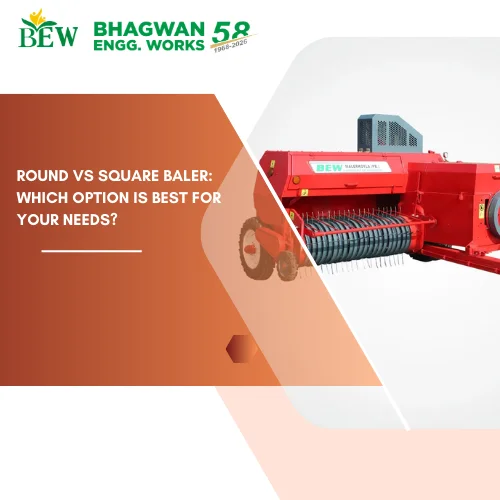
Choosing the right baler is an important decision for farmers involved in hay, straw, or fodder management. The type of baler you select directly affects storage, transportation, feeding efficiency, and overall farm productivity. Two of the most common options available today are round balers and square balers. Each has its own advantages, and the best choice depends on your farm size, crop type, labor availability, and storage capacity.
In this guide, we’ll compare round and square balers to help you determine which option suits your specific agricultural needs.
Understanding Round Balers
Round balers produce cylindrical bales by rolling crop material into a tight, compact shape. These machines are widely used for hay and straw baling, especially on medium to large farms.
Advantages of Round Balers
1. Weather Resistance
Round bales naturally shed water due to their curved shape. This makes them more suitable for outdoor storage when covered properly.
2. Lower Labor Requirements
Round balers are typically more automated. Once the bale reaches the desired size, the machine wraps it and ejects it with minimal manual effort.
3. Efficient for Large Fields
They are ideal for large-scale operations where high output and quick field clearing are essential.
4. Flexible Bale Size Options
Many models allow adjustment of bale diameter and density depending on crop type and storage needs.
Limitations of Round Balers
- Round bales require more storage space.
- Transporting cylindrical bales can be less efficient due to stacking limitations.
- Feeding livestock may require specialized equipment.
Understanding Square Balers
Square balers produce rectangular bales that are easier to stack and transport. They are commonly used in small to medium farming operations.
Advantages of Square Balers
1. Easy Storage and Transport
Square bales stack neatly, maximizing storage space and making transportation more efficient.
2. Convenient Handling
Small square bales can often be handled manually, making them ideal for farms with limited machinery.
3. Better for Commercial Sale
Uniform rectangular bales are often preferred in commercial markets due to ease of packaging and shipping.
4. Suitable for Small Farms
Square balers are often more practical for smaller acreage and diversified farming operations.
Limitations of Square Balers
- They may require more labor for collection and stacking.
- Less resistant to weather if stored outdoors without protection.
- Larger square balers can require higher horsepower tractors.
Key Factors to Consider Before Choosing
When deciding between round and square balers, evaluate the following factors:
1. Farm Size
Large farms with high crop output may benefit from the speed and automation of round balers. Smaller farms may find square balers more manageable and cost-effective.
2. Storage Facilities
If you have limited storage space, square bales are easier to stack and organize. Round bales require more open space and proper covering.
3. Labor Availability
If labor is limited, round balers offer more automation and reduce manual handling. Square balers, especially small ones, may involve more manual stacking.
4. Transportation Needs
For long-distance transport or commercial selling, square bales are generally easier to load and stack on trucks.
5. Livestock Feeding Requirements
Round bales are commonly used in large-scale livestock feeding systems. Small square bales are often preferred for controlled feeding in smaller operations.
Cost and Long-Term Value
Both round and square balers vary in price depending on size, automation level, and brand. When searching for the best baler Machine, it’s important to compare not only the purchase cost but also maintenance expenses, fuel efficiency, spare parts availability, and long-term durability.
A machine that fits your operational needs will provide better returns over time, even if the initial investment is slightly higher.
Maintenance and Durability
Regular maintenance is essential regardless of the baler type. Round balers may have more moving parts due to their rolling mechanism, while square balers rely heavily on plunger systems that require periodic inspection.
Choosing a reliable manufacturer and ensuring proper servicing will significantly impact machine lifespan and performance.
Which Option Is Right for You?
There is no universal answer when choosing between round and square balers. The right option depends on your farming goals:
- Choose a round baler if you operate on large fields, need automation, and plan to store bales outdoors.
- Choose a square baler if you prioritize easy stacking, efficient transport, and smaller-scale operations.
Ultimately, the best decision comes down to balancing operational efficiency, labor capacity, storage space, and budget.
Conclusion
Both round and square balers offer unique advantages for crop residue and fodder management. By carefully evaluating your farm size, storage facilities, labor availability, and market needs, you can select the baler that aligns with your objectives.
Investing in the right equipment ensures better productivity, reduced waste, and improved profitability season after season. The key is to match the machine’s capabilities with your specific agricultural requirements for long-term success.
best